This case study describes work disclosed publicly by Syngenta Crop Protection in international patent application WO 2025/221857 A1. It is presented only at the level of detail contained in
that published filing.
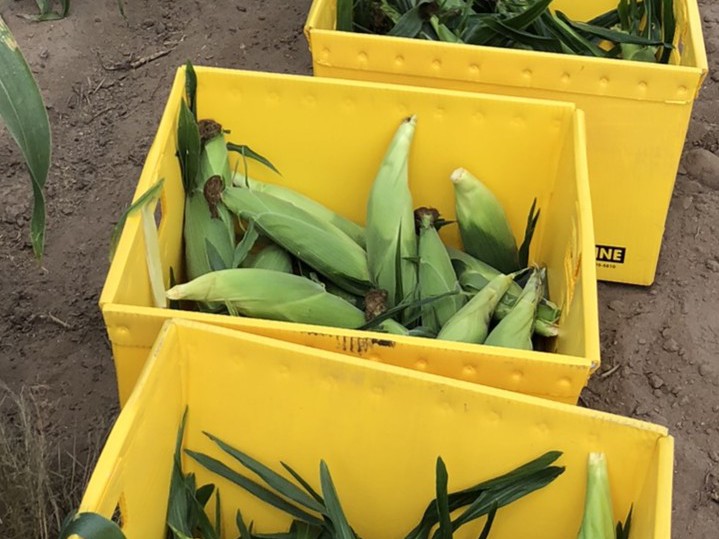
In sweet corn breeding, advancement decisions live or die on the quality of phenotype data — and that data is expensive to get. Ears are assessed when they reach maturity, roughly 21
days after pollination, and the window is unforgiving: ideally an entire trial location is harvested in a day or two, because if harvest drags out, harvest date itself becomes a confounding variable
in the results.
The long-standing way to work inside that window was manual and thin. A person walks into a plot, selects perhaps five "typical" ears at random, takes a mix of objective measurements and
subjective calls on them, and extrapolates that handful to the whole plot. It's fast, but it's fragile: small samples are noisy, larger samples cost labor and time the window doesn't allow, and
subjective assessments introduce selection and estimation bias. Breeders were being asked to make high-stakes advancement calls on data that was both sparse and partly opinion.
I conceived and led the development of a different approach: capture the phenotype data during harvest itself, instead of treating measurement as a separate manual step.
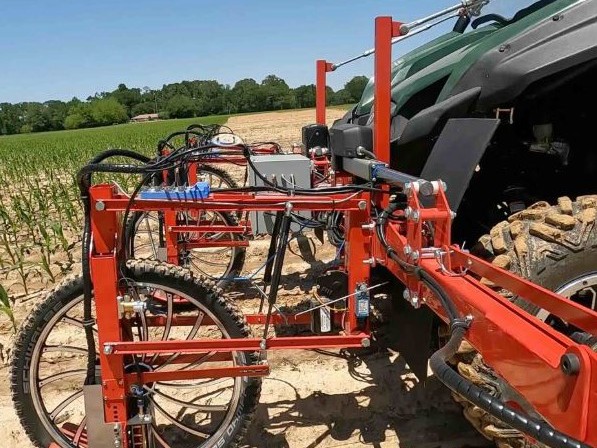
The core idea was to modify existing harvest machinery so that it gathers precise optical, mass, and positional information on the ears as they are collected — while keeping the
equipment transportable and easy to deploy across a research trialing network. Each measurement is automatically tied to precision GPS coordinates and plot barcode information, so every data point is
associated with the correct plot with no manual tracking and no transcription step.
The effect is to break the accuracy-versus-labor tradeoff that constrained the old method. Sample size scales up from a handful of ears toward the whole plot; objective quantitative
measurement replaces eyeballing; and marketability traits can be assessed with enough confidence to advance the strongest plants earlier in the breeding pipeline. I am the first-named inventor on the
resulting patent, working with a cross-functional team of engineers, mechanics, and system integrators as co-inventors.
The immediate, tangible outcome is a protected invention on the public record. International patent application WO 2025/221857 A1, "Method and System for Harvesting
a Crop," was published on 23 October 2025 under the Patent Cooperation Treaty, carrying a priority date of April 2024. The assignee is Syngenta Crop Protection,
and the filing names six inventors — with me first among them. Anyone can retrieve the full published document and verify the concept, the claims, and the inventorship directly.
Because it was filed as an international (PCT) application rather than a single-country filing, the invention retains the option to pursue protection across the world's major
agricultural markets — a reflection of the value placed on solving the problem thoroughly rather than quickly.
Beyond the IP asset itself, the filing documents what the invention changes in practice. The established method leaned on roughly five hand-selected ears and a blend of objective
measurement and subjective judgment; the disclosed system replaces that with objective, quantitative measurement at whole-plot scale, captured as the ears are harvested and bound automatically to the
correct plot. The downstream consequence, as the filing describes it, is higher-quality and higher-volume trialing data with less bias built in — data that breeders can rely on with more confidence
when deciding which plants to advance, and that lets the most marketable material move forward in the pipeline earlier than the old approach allowed.

 Agricultural Research Consulting
 Print
Print 